
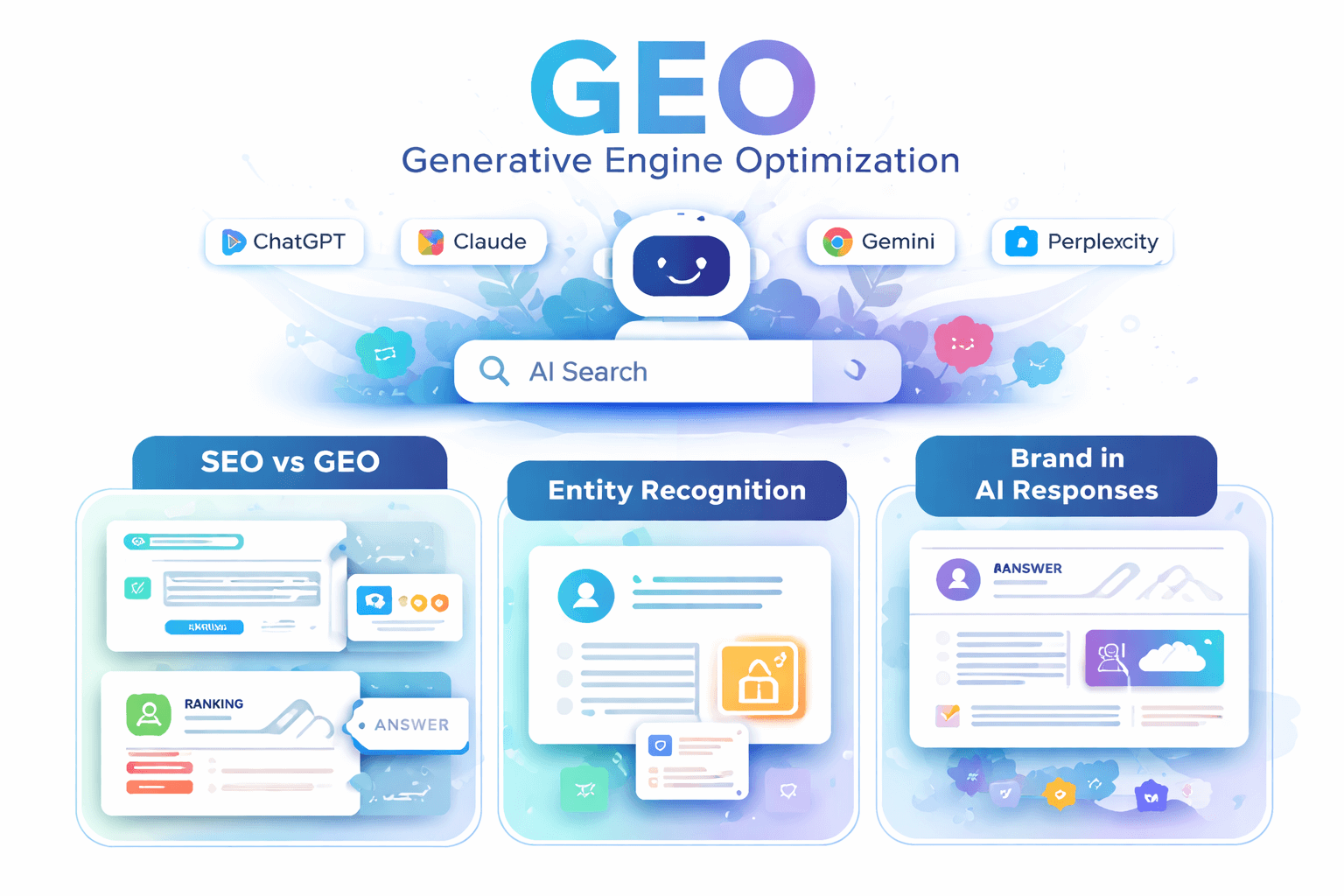
This article explains what GEO is, how it relates to terms like AEO, LLM SEO, and AI SEO, why it matters for businesses, and how to track visibility in AI-generated answers.
Search is changing faster than at any point in the last 20 years.
People are no longer relying only on blue links and rankings. Instead, they are asking questions directly to AI systems like ChatGPT, Claude, Google Gemini, and Perplexity — and getting direct answers, recommendations, and summaries.
This shift has given rise to a new discipline called Generative Engine Optimization (GEO).
What Is Generative Engine Optimization (GEO)?
Generative Engine Optimization (GEO) is the practice of optimizing your content, brand, and digital presence so that AI-powered search engines and large language models (LLMs) can understand, trust, and reference your website when generating answers.
Unlike traditional SEO, which focuses on ranking web pages in search results, GEO focuses on:
- Being mentioned
- Being summarized
- Being recommended
- Being cited or paraphrased
In simple terms:
SEO helps your website rank.
GEO helps your brand become the answer.
Why Are There So Many Terms: GEO, AEO, LLM SEO, AI SEO?
As AI-powered search evolved, multiple terms emerged to describe different aspects of optimization.
Answer Engine Optimization (AEO)
AEO focuses on optimizing content to appear as direct answers in featured snippets, voice search, and AI responses. It is mostly centered on question-and-answer formatting.
AI SEO
AI SEO is a broad umbrella term that can mean either using AI tools for SEO or optimizing content for AI-driven discovery. It lacks a precise definition.
LLM SEO
LLM SEO focuses on making content understandable for large language models. This includes clarity, context, structure, and entity recognition.
Generative Engine Optimization (GEO)
GEO is the most comprehensive term. It includes AEO concepts, LLM understanding, entity authority, brand trust, and content credibility.
This is why GEO is increasingly used as the preferred term for optimization in AI-driven search environments.
Why GEO Is Required Today
AI platforms already influence how people discover brands, compare services, and make buying decisions.
When users ask AI systems questions like:
- Which is the best service provider for my business?
- What tools should I use for a specific problem?
They often never visit traditional search results.
If your brand is not understood or trusted by AI systems, you become invisible in this new layer of search.
What Happens If a Business Does Not Invest in GEO?
Businesses that ignore GEO face silent but serious risks:
- No presence in AI-generated recommendations
- Competitors being mentioned instead
- Declining brand discovery
- Loss of authority to third-party sources
- Buyer perception shaped without your input
If SEO protects rankings, GEO protects relevance.
How GEO Works
GEO helps AI systems answer three fundamental questions:
- Who are you?
- What are you known for?
- Can you be trusted?
To do this, GEO focuses on:
- Clear brand and entity definitions
- Topical authority
- Consistent signals across the web
- High-quality explanatory content
- Real-world credibility
How GEO Works Across AI Platforms
GEO in ChatGPT
ChatGPT favors content that is well-structured, educational, and clearly written. Strong topical depth and trusted public sources increase influence.
GEO in Claude
Claude emphasizes accuracy, context, safety, and long-form understanding. Neutral, non-promotional, educational content performs best.
GEO in Google Gemini
Google Gemini aligns closely with Google Search systems. It favors authoritative websites, strong E-E-A-T signals, and consistent SEO foundations.
GEO in Perplexity
Perplexity highlights sources and citations openly. Clean information architecture and credible factual content improve visibility.
How to Track Your Website in GEO
Tracking GEO is different from tracking rankings.
Prompt Testing
Manually ask AI platforms questions related to your business and check if your brand or content is mentioned.
Citation Monitoring
Track whether AI tools like Perplexity reference your website as a source.
Brand Mention Analysis
Monitor brand mentions and consistency across the web. AI systems learn from repeated patterns.
Search Console Signals
While Google Search Console does not show GEO directly, improvements in branded and informational queries often correlate with stronger AI visibility.
Conclusion
Generative Engine Optimization is not a trend — it is a structural shift in how information is discovered and trusted.
Search engines are becoming answer engines. Websites are becoming knowledge sources. Brands are becoming entities in AI systems.
Businesses that invest early in GEO will shape how AI talks about them and stay visible as search behavior evolves.
In the age of AI search, visibility is not just about ranking. It is about being referenced, trusted, and repeated.